PALIKIR, Pohnpei, October 15, 2026 – The Federated States of Micronesia has launched the first pilot tests under the FSM Skills Certification Unit (SCU), a major step toward strengthening its workforce.
The initiative enables people to demonstrate workplace abilities and gain formal recognition. Unlike academic qualifications, skills certification verifies competence in a specific occupation.
It can recognize skills gained through college, work, or other learning and experience.
Building a new national system
The World Bank-financed Skills and Employability Enhancement (SEE) Project established the initiative, which the National Department of Education and Department of Resources and Development jointly implement.
Hosted by the Department of Resources and Development, the Unit was accredited in May 2026 by the National Accreditation Center under ISO/IEC 17024:2012, the international standard for organizations certifying people.
This gives FSM an independent mechanism to assess occupational competence.
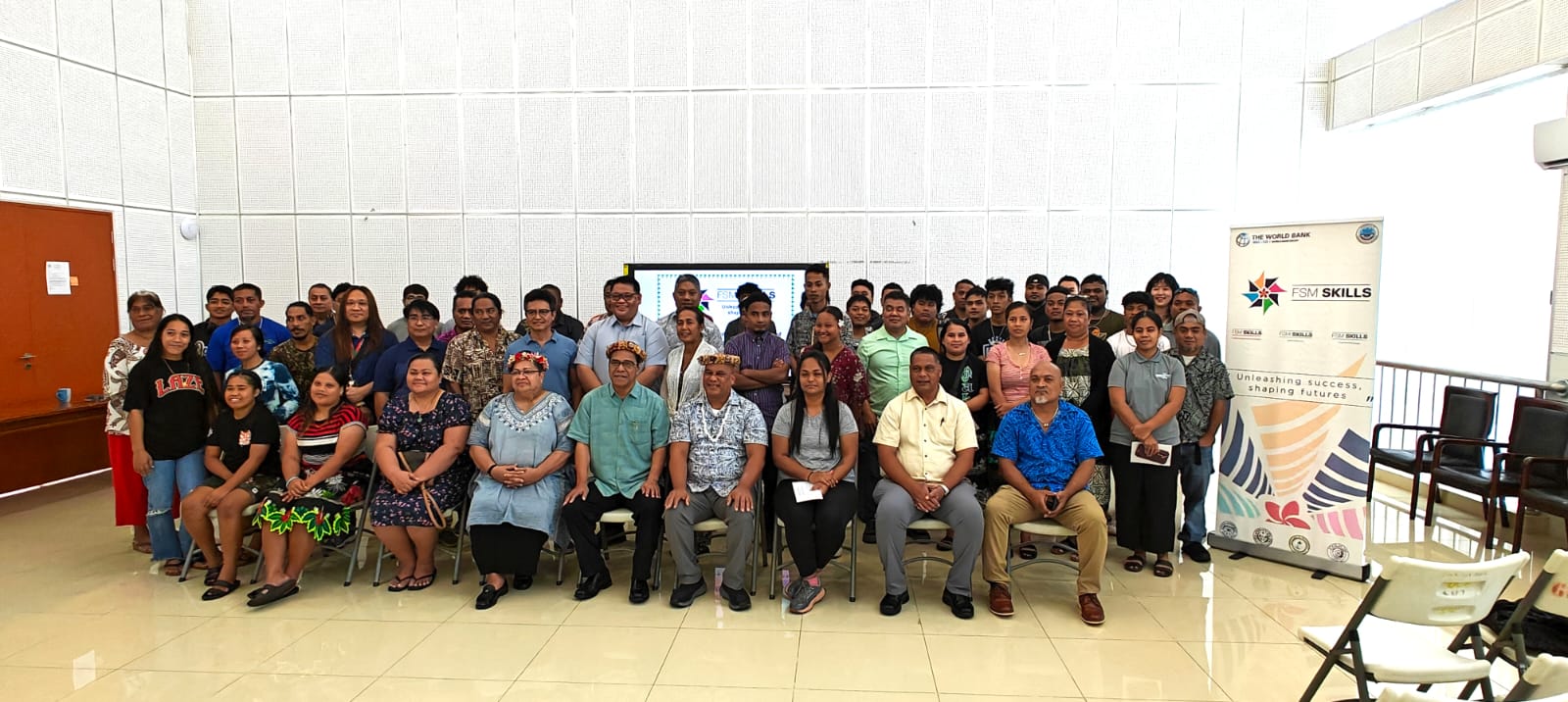
National and state leaders, education partners, assessors, examiners, and applicants attended the October 15 opening at the Pohnpei State Governor’s Conference Room.
Speakers included Pohnpei Governor Stevenson A. Joseph, FSM President Wesley W. Simina, and College of Micronesia-FSM President Theresa Koroivulaono.

From qualifications to demonstrated skills
President Simina said qualifications show that a person has completed a course, while certification proves they can perform the practical work required for a job. He emphasized that skills gained through college, work, apprenticeships, or other training should be formally recognized. He said the system would help workers prove their abilities, employers recruit skilled people, and training providers respond to workforce needs.
The first pilot will put the national system into practice, assessing 45 college graduates across five occupations.
The pilot covers PC Repair and Support Technician, Residential Electrician, HVAC Technician, Consumer Electronics Service Technician, and Telecommunications Technician.
The broader framework also covers tourism and hospitality, agriculture, accounting and bookkeeping, construction, and other technical fields.
Learning from the pilot
Beyond assessing candidates, the pilot will test standards, practical assessment methods, quality assurance, and operating systems to identify improvements.
Two more testing rounds are planned before the SEE Project grant ends in June 2027.
The National Government plans to institutionalize certification beyond the project, working with FSM States to recognize occupational competence and link skills development with employment.
Employers and industry practitioners will help shape standards, review assessments, support quality assurance, and recognize certification in recruitment and workforce development.
Creating pathways to opportunity
Ultimately, the initiative aims to make skills visible and valuable.
Certification helps workers validate skills and identify training needs, gives employers confidence in recruits, and guides training providers on needed skills.
As FSM moves beyond pilot testing, the goal is a trusted national certification service that continues after the SEE Project.
The pilot marks the start of a system thatformally recognizes abilities, expands opportunity, and gives employers greater confidence in workforce skills.